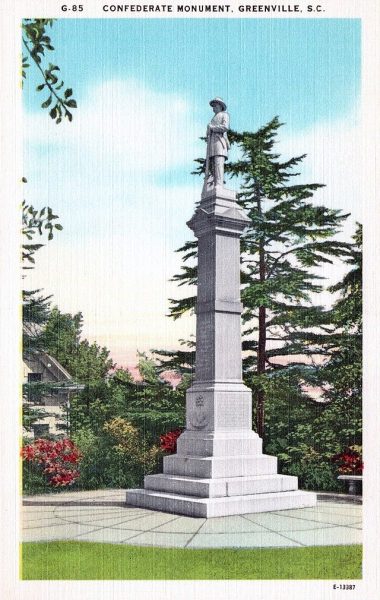
The Georgia House of Representatives voted Tuesday, March 31, against a proposal aimed at protecting Confederate monuments, highlighting the ongoing debate across the state and the nation over how history should be remembered and represented in public spaces.
In an article published by WADE.org, Senate Bill 175 would have granted legal permanence to monuments and allowed legal action in cases of attempted removal or destruction. The bill also proposed relocating monuments to public sites rather than demolishing them if local governments declined to maintain ownership. Supporters framed the legislation as a way to preserve historical artifacts, while critics argued it would limit communities’ ability to decide what is appropriate for their public spaces.
Supporters of the legislation argued that it was not limited to Confederate memorials but applied broadly to all monuments honoring the dead. Republican Rep. Alan Powell emphasized that point during the session of the Georgia House of Representatives on that Tuesday at the state capitol, attempting to shift the conversation away from the Confederacy specifically and toward a broader discussion of remembrance.
“I will not talk about history. I will not talk about the Confederacy. I am not going to talk about slavery,” Powell said. “This bill encompasses all monuments.”
Opponents, however, said the measure risked promoting prejudice rather than preserving history. They argued that, regardless of how the bill was framed, Confederate monuments carry a specific historical meaning tied to slavery and racial oppression. Democratic Rep. Tanya Miller argued that Confederate monuments honor figures who fought to preserve slavery, making their presence in public spaces deeply controversial.
“The people who we are memorializing in these Confederate monuments went to war with their own countrymen over slavery,” Miller said.
The bill ultimately failed to pass the House, reflecting the divided opinions among lawmakers and constituents. While some saw the bill as a necessary protection of history, others viewed it as an obstacle to social progress and community autonomy.
Faculty at GCSU offered historical context for the ongoing debate, helping to frame the issue beyond current political disagreements. History professor Aran MacKinnon said many monuments were created to present a selective interpretation of the past, rather than a neutral or comprehensive record of history.
“These monuments were designed to project a selective view of the Southern past and to invent new traditions that would serve as a symbolic bastion against change,” MacKinnon said, adding that they also functioned as resistance to racial equality.
Fellow history professor James Welborn expanded on that perspective, explaining that many monuments were erected during periods when social hierarchies were being challenged, particularly in the decades following the Civil War and during the Civil Rights Movement.
“They were for reasserting and perpetuating white supremacy and patriarchal authority in the social structures, cultural values and power dynamics of the American South,” Welborn said.
Philosophy professor Sabrina Hom added another layer to the discussion by emphasizing the importance of context when evaluating monuments. She suggested that not all monuments serve the same purpose or carry the same meaning, and that intent matters when determining whether they should remain.
“If a monument is erected by a family or a community that wants to memorialize somebody important to them, it has a very different context than something erected as a threat,” Hom said.
Students at GCSU reflected a range of views on the issue, illustrating how younger generations continue to grapple with questions about history, memory and public representation. Sophomore business management major Lorren Connelly said removing monuments risks erasing history, expressing concern that future generations may lose touch with the past.
“Taking away the statues is trying to cover up past failures,” she said. “There is no reason to erase history by doing so.”
Junior history major Hannah Beth Chapman disagreed, arguing that the meaning of monuments is not fixed and can change over time as society evolves. She suggested that removing monuments can be a way of rejecting harmful symbols rather than denying history.
“Statues take on the symbolism of their time,” Chapman said. “Taking these monuments down is not erasure. It is taking down symbols of cruelty.”
Sophomore psychology major Peyton Gaines offered a more nuanced perspective, suggesting that the issue involves both acknowledging and correcting history. Gaines emphasized the importance of presenting multiple perspectives to better understand the past.
“The removal of the monuments is both erasing and correcting history,” Gaines said. “It is important to have items that depict all sides of history to have a better understanding of events and their reasons.”
Despite their differing opinions, students generally agreed that decisions about monuments should involve broad input rather than being left to individuals or small groups. Many emphasized the importance of dialogue and collective decision-making in addressing such a complex and sensitive issue.
“No one should decide on their own because the debate has two sides,” Gaines said. “Maybe it should be a collective decision across different groups.”
Chapman added that responsibility for such decisions should depend on ownership and jurisdiction, suggesting a layered approach to governance.
“If it is federal, then the government should decide. If it is local, then it should be a local discussion,” she said.
Students who want to follow or participate in discussions about monument policy can monitor state legislation and take part in community forums or campus discussions.