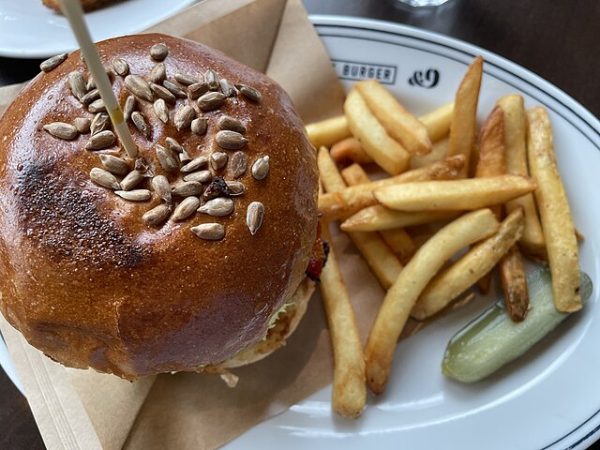
Football fans attending this past Super Bowl were met with a new item on the concessions menu: a $180, 3.5-pound luxury burger featuring a braised bone-in-beef shank topped with mirepoix demi-glace and finished with a rich Point Reyes blue cheese fondue.
The burger, named the LX Hammer Burger, was created and sold at Levi’s Stadium as a limited-edition item meant to be shared by four people. The stadium reportedly only made 200 of these gourmet burgers.
The addition of this item on the menu is part of a larger scale trend involving an increase in luxury items on stadium menus, such as the $39 Lob Dog at Petco Park, a grilled lobster tail with chorizo sausage served on a brioche bun with a lemon garlic aioli and the $99 All-Star Axe at Truist Park, a tomahawk ribeye with demi-glace and served with a baked potato.
But the LX Hammer Burger takes the cake for the most expensive concession item sold to date.
These over-the-top luxury menu items have spurred conversations among sports fans about the future of the concession stand menu. Saree Brookshire, a sophomore accounting major, believes that it is an outrageous trend.
“I think that’s unnecessary, because the point of the game is the cheap food,” Brookshire said.
Other fans share her sentiment that the money fans spend on the event should not be spent solely on concessions.
“I feel like if you are going to a sporting event, you shouldn’t be wanting $180 cheeseburger, you should be wanting $2 nachos,” said Zach Scott, a freshman finance major.
However, some think it may enhance the experience and would like the chance to try it one day.
“If I did have the income, and there was something really cool that the stadium was offering that was unique to them and it was a luxury item, I would be willing to buy it,” said Logan Faas, a junior management major.
In addition to an increase in luxury items on the menu, sports fans have also noticed an increase in the prices of traditional items, such as hot dogs, nachos and beer, over the past two decades.
Factors such as inflation and captive markets—markets where the consumers have a limited number of competitive suppliers, so their only choices are to purchase what is available or to make no purchase at all—in stadiums have driven up concession prices by over 40% in some cases.
According to data reported by Statista on the average concession stand prices in the National Football League, a sports fan could buy a hot dog in 2006 for three to four dollars at an average stadium game; in 2023, the same hot dog could cost six dollars, leading fans to pay more in concessions.
“I’m kind of prepared to spend anywhere between $20 to $40 [at the concessions stand],” Faas said.
Despite these cost increases, fans are still willing to take out their wallets at the concession stands.
“The food experience is the most important part for me. It’s nostalgic, when you go to a game, you get a hot dog and a coke,” Brookshire said.