GCSU is taking part in the 2026 Campus Race to Zero Waste this spring, joining more than 1,000 colleges and universities across the U.S. and Canada in an eight-week competition focused on reducing food waste and improving sustainability efforts.
The Campus Race to Zero Waste encourages schools to track how much waste they reduce throughout the competition. The program began in 2001 and has expanded into a nationwide sustainability initiative.
At GCSU, the focus this year is on composting food waste from The MAX dining hall. Caroline Efird, a junior environmental science major and events coordinator intern for the Office of Sustainability, explained how the competition works.
“It’s a competition between United States and Canadian universities, and it’s basically to inspire, empower and mobilize students and faculty to improve efforts to reduce waste,” Efird said.
During the eight-week period, GCSU tracks how much food waste is collected from The MAX and reports that data to the competition website.
“We report our compost data that’s being collected from The MAX, and I enter it into the website,” Efird said. “Then you’re competing to see who is able to reduce the most food waste or recycling around campus.”
Efird said the competition allows schools to track their progress and compare results with other campuses. She said this year’s main goal is to consistently report compost numbers and encourage students to be more aware of food waste.
“The goal for this year is just to report our compost statistics in pounds to the Campus Race to Zero Waste organization,” Efird said. “We’re focusing on compost reporting and promoting food waste reduction across campus.”
On average, about 400 pounds of food waste are collected from The MAX each day.
Shira Funk, a junior environmental science major and compost intern, said she and fellow compost intern, Micheal Zindel, manage the compost process from start to finish.
“We take the food waste from The MAX and weigh it every day.” Funk said. “On average, we collect around 400 pounds of food waste per day. It is then mixed with sawdust, which is also weighed, and brought into the composter for it to process and allow bacterial processes to occur to make nutrients that plants can use,”
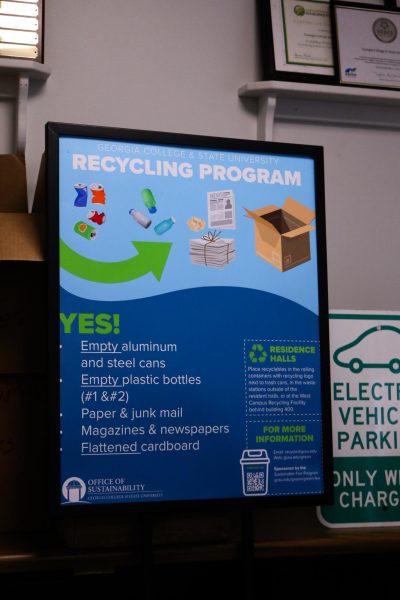
In addition to composting, the Office of Sustainability supports other waste reduction efforts across campus. The office collects glass at drop-off locations on Front Campus and West Campus, recycles ink cartridges and helps offices dispose of cardboard. Programs like “Dodge the Dump” during move-in and move-out also help reduce waste by collecting unwanted items and donating them to local nonprofit organizations.
Dr. Micheal Hejazi, Director of Environmental Health, Safety and Sustainability, said the competition supports GCSU’s long-term waste reduction goals.
“This program is designed to help colleges and universities develop solutions that support zero-waste goals, specifically by diverting at least 90% or more of food organics from the trash stream,” Hejazi said. “It serves as an additional tool for advancing GCSU’s sustainability efforts to reduce or eliminate waste.”
Hejazi said students play an important role in making the program successful, from daily compost collection to supporting sustainability efforts throughout the year.
“Several students are already involved and help ensure the program runs smoothly,” Hejazi said.
As the competition continues this spring, campus leaders hope the program will encourage students to think more about where their waste goes and how small actions can make a difference. Through daily composting efforts, GCSU continues working toward reducing waste on campus.