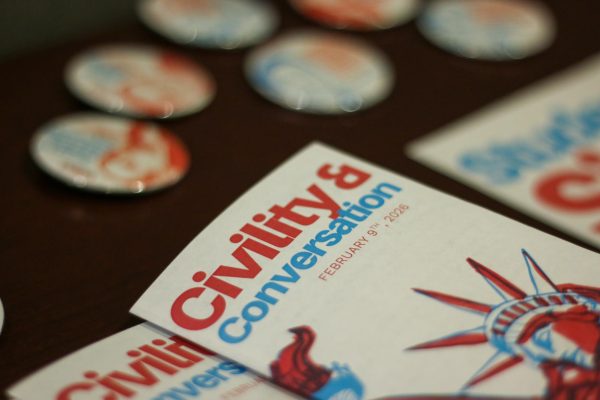
Students representing four campus political organizations gathered Monday, Feb. 9, in the Pat Peterson Room from 6 to 7:30 p.m. for a structured political forum focused on civil discourse. The event featured members of Turning Point USA, College Republicans, Mutual Aid Society and Young Democrats.
The stated goal of the forum was to encourage engagement across differences while maintaining civility. Throughout the 90-minute event, moderators enforced a 1-minute and 30-second time limit and transitioned between topics without open debate between speakers.
Organizers said the event was created in response to what they described as growing political tension and distance among students.
The first topic addressed U.S. foreign policy, an issue that often reflects the divide about the country’s role in global affairs. Participants were asked to respond to questions about international involvement and national interest.
“For too long, America has acted as the world’s police force,” said Ellie Prothro of Turning Point USA, expressing concern about extended military and political involvement abroad.
A representative from Mutual Aid Society argued that U.S. foreign policy primarily serves American interests and described it as aligned with imperialism.
College Republicans framed the issue around international enforcement and global competition. Representatives said international institutions such as the United Nations are frequently bypassed and argued that if adversaries do not follow established rules, the United States should not feel obligated to do so unilaterally.
A speaker from Young Democrats focused on economic dimensions, saying U.S. foreign policy often advances corporate interests rather than those of working-class Americans.
The conversation then shifted to gun legislation, a topic that remains controversial in national debate. Participants were asked to address constitutional rights and public safety considerations.
A Mutual Aid Society speaker argued that firearm ownership enables communities to defend themselves when necessary. The Black Panther Party, a revolutionary organization advocating for Black nationalism and socialism, was mentioned as a historical example of organized armed self-defense.
College Republicans cited the Second Amendment as the foundation of their position, stating that gun ownership is a constitutional right and that government involvement should remain limited.
A Young Democrats representative said individuals have the right to bear arms, but emphasized safe and responsible ownership practices.
Turning Point USA expressed support for gun rights in line with limited government regulation. The organization also advocated for legislative efforts that protect individual liberties and uphold constitutional freedoms.
Immigration policy produced some of the clearest contrasts of the evening. The issue was framed around border security, legal processes and humanitarian considerations.
College Republicans said legal immigrants should be welcomed and called for reforms to improve the current system.
“No one wants to see families separated,” said Owen Jordan, second vice chair of the organization, while also emphasizing the need for secure borders.
Young Democrats argued that immigration patterns are closely connected to U.S. foreign policy decisions and suggested that addressing root causes abroad is necessary for long-term solutions.
Turning Point USA maintained that violations of immigration law require enforcement and consequences, focusing on adherence to existing statutes.
“ICE is the tool of imperialists,” said Patrick Lingafelt of Mutual Aid Society, criticizing federal immigration enforcement practices and their broader political implications.
The final major topic centered on social welfare programs. The discussion touched on federal policy, economic security and family structure.
Young Democrats advocated for expanding the Affordable Care Act and protecting Social Security, arguing that federal programs provide essential support for vulnerable populations.
Turning Point stressed the importance of strengthening the nuclear family as a social foundation. Mutual Aid Society called for broader systemic changes to better support families, suggesting structural reform rather than incremental policy adjustments.
College Republicans argued that current welfare programs are not structured to promote long-term independence, raising concerns about sustained reliance on government assistance.
The event concluded with a brief discussion of President Donald Trump’s handling of Venezuela, with Turning Point USA and College Republicans believing the American government had a duty to protect the people of Venezuela.
The release of files related to Jeffrey Epstein was also briefly mentioned, with all parties agreeing that the distribution of the files was poorly done. Audience members listened throughout the discussion, with occasional reactions but no disruptions.
“I feel this event went really well in promoting intercampus understanding and discourse,” said Westray Schultz, vice president of Young Democrats. “I believe that we can do much better in the future regarding this, but this is a great start.”
Students interested in continuing the conversation can attend future forums, connect with the participating organizations or seek out additional campus discussions focused on civic engagement and respectful dialogue across political differences.