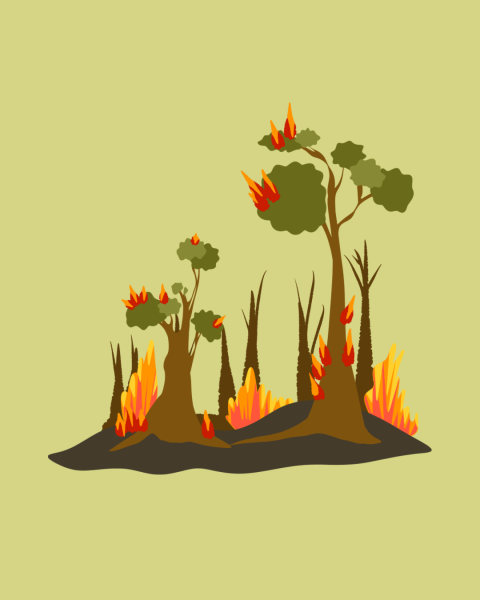
Smoke from wildfires across the U.S. is contributing to premature deaths each year, according to new research examining the long-term health effects of air pollution.
A study published Feb. 4 in Science Advances found that air pollution from wildfire smoke has caused an average of 24,054 deaths annually in over 95% of states in the U.S. from 2006 to 2020.
The smoke pollutes the air in the form of particulate matter, meaning we breathe it in daily. Milledgeville generally has moderate PM2.5 levels, often within the Moderate category on air quality indexes, meaning some pollution exists but is not always at unhealthy levels. On occasional days, localized conditions (weather, traffic, seasonal smoke) can push PM2.5 higher, potentially making the air unhealthy for sensitive groups.
PM2.5 refers to particles about 30 times smaller than the width of a human hair, small enough to enter the lungs and bloodstream. This undetected inhalation is where the health concerns stem from.
The study has found strong links between long-term exposure to PM2.5 and increased risk of cancer, mental disorders, circulatory, respiratory, endocrine, metabolic and nutritional diseases.
PM2.5 is also released by global occurrences like industrial emissions and vehicle exhaust. However, the study found wildfire-related PM2.5 was associated with mortality rates up to five times higher than other sources of fine particulate pollution.
“I consider wildfire smoke kind of like tobacco smoke without the nicotine,” said John Balmes, a professor of environmental sciences at the University of California, and an expert on air pollution.
The inhalation effects are more prevalent in cool weather and rural areas, as well as more detrimental to communities with younger populations. Firefighters face elevated exposure risks as well.
“My grandfather briefly worked for the U.S. Forest Service. The majority of all of the smoke jumpers he worked with had health complications at some point due to excess smoke inhalation,” said Parker Davis, a sophomore environmental science major and aspiring firefighter.
According to federal fire data, most U.S. wildfires are started by human activity. However, the U.S. Environmental Protection Agency (EPA) classifies them as natural disasters, which are considered outside the jurisdiction of local authorities.
Because wildfire smoke is generally classified as a natural event under federal air quality rules, states face limits in how those emissions are regulated under the Clean Air Act.
“I believe that more of the [EPA] budget needs to be hedged towards the prevention of wildfires and a change in climate policy concerning fuel efficiency and waste reduction,” Davis said.
Among possible regulators are prescribed burns, which involve professionals intentionally igniting a specific land area in order to reduce flammable vegetation, which also revitalizes the environment before a wildfire can occur.
Associate Professor of Biology Bruce Snyder, who currently teaches wildfire ecology, believes prescribed burns are the most efficient solution for controlling wildfires and directing where the smoke is spread.
“Things are going to burn one way or another, and doing prescribed fire is really a very useful way to do that in a more managed fashion,” Snyder said. “It can then allow us to, when those wildfires do show up, have systems that are going to be able to handle that effectively.”
The scientists behind the study also advise increased monitoring of air quality, issuing smoke warnings and air purification measures in heavily affected areas.
Isabella Trickey, a sophomore psychology and philosophy double-major, believes that care options for the people and areas affected by the smoke are just as important as wildfire prevention.
“We need to start offering medical solutions for people who already have pollution and prioritize them,” Trickey said. “Not only are we hurting people with this pollution, we’re also killing animals and killing viable and fertile environments that we need.”
The study suggests that the long-term public health effects of the smoke are a call to action for more attention to and control of wildfire smoke.
For more information, students should review the study entitled “Wildfire smoke PM2.5 and mortality rate in the contiguous United States” at science.org. Additionally, recommendations for wildfire prevention and management can be found on the National Interagency Fire Center website.