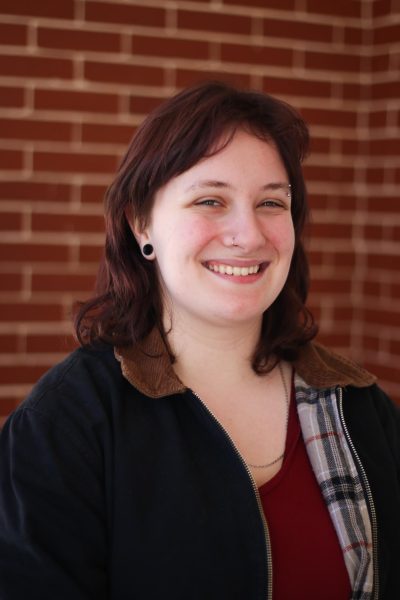
Chloe Melton, a junior history major, recently published research on the history of the body mass index (BMI) in the Human Anatomy and Physiology Society (HAPS), a peer review and open source journal, gave a TEDx Talk and had her work added to a prestigious anatomy textbook.
Melton’s research revealed that BMI’s history and origin are the crucial keys to its inaccuracies and implications on health science.
At the age of 14 years old, Melton struggled with her self-image and developed an eating disorder. This led her to question the legitimacy of BMI, a simplified measure of health that often creates a stigma around weight.
“When I was 14, I actually suffered from anorexia and went to a residential home treatment center,” Melton said. “That was the first time that my conceptualization of BMI had actually been challenged beyond what you’re kind of normally told.”
BMI is a measure of body fat based on height and weight and is used as a measure of health. However, it doesn’t take into account muscle mass, bone density or body composition.
Melton did not start out with the intention to write a research paper. She was recommended to do research by the Dean of the Honors College, Brian Newsome.
When Melton figured out she wanted to do work surrounding BMI, she originally went to see Helen Dupree, lecturer of Public Health and member of the National Eating Disorders Association, to focus on something related more to the science of the index, but was turned down in the interest of time.
“Originally, we were going to do something more scientific, something kind of empirical, and she turned me away because she said I don’t think that we can do this in 10 days,” Melton said.
Later, however, Dupree reached out to Melton about looking at BMI from a more historical lens, a perspective not many people have used before regarding this topic. With her abstract formed, Melton started her honors independent research under the mentorship of Newsom.
“People don’t talk about the history of BMI.” Melton said. “They just kind of talk about the science behind it, but they really go hand in hand,”
Melton later presented her work at the Georgia College Honors College Conference (GCHC) and the Southern Regional Honor Conference (SHRC), which serve as chances for students to show off their research to peers and others in similar fields. That is not where her journey stopped.
Newsome was having lunch with Kenneth Saladin, a distinguished professor emeritus of biology, and talking about Melton’s research. Saladin realized that the research could be a good contribution to his book, one of the biggest Anatomy and Physiology (A&P) textbooks in the country.
Saladin then edited a sidebar essay in his textbook based on Melton’s paper, but Melton wasn’t finished sharing her research. After five edits with Saladin and another revision after that, Melton was able to publish her work in the HAPS.
Melton was then chosen to give a TEDx Talk on her research, being one of three students chosen to do so that day. She was able to expand her reach even further, but also come full circle with the story of her 14-year-old self.
Melton said that when she was 14, she would look for TED Talks that were inspirational. Now, getting her own moment on stage meant a lot to Melton, because it meant doing something she couldn’t dream of doing at 14.
“I think I would tell [my 14-year-old self] that some of my biggest fears right now don’t matter,” Melton said. “You’re going to be okay. You have to hold on because you’re going to do so many amazing things.”
Even in the chaos of research and TEDx Talks, Chloe Melton is also a student, barista at Black Bird Coffee, and an executive member of multiple clubs. She is able to find a balance between all of these parts of her life through her friends and her passion for this project.
“I got through this [eating disorder] for a reason.” Melton said. “I learned all of this for a reason. I want to help other people who are going through the same things that I was going through.”