

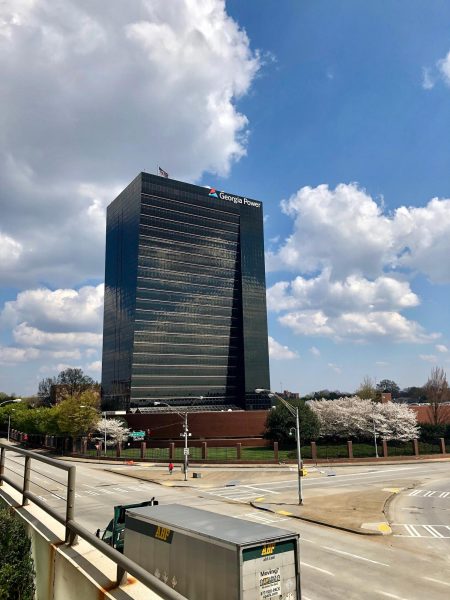
The Georgia Power company has recently requested a large amount of electricity to power data centers across the state, which has raised ethical and environmental questions among students and staff at GCSU.
“It’s hard to think about all the amazing things AI could potentially do for humans if our future generations won’t be able to see them accomplished,” said Madi Hummel, a junior marketing major. “I’m hopeful that as we begin to understand the effects AI has on our society, we’ll be able to find solutions to make the data centers more sustainable.”
Hummel recognizes the positive effects Artificial Intelligence can have on society, but is concerned about the negative long-term effects on the environment. The conversation of sustainability has been present following Georgia Power’s 10-gigawatt request for electricity.
The reasoning behind Georgia Power’s request is the exponential advancement of Artificial Intelligence. Society has seen a significant uptick in AI usage and the company is attempting to accommodate its energy requirements by requesting additional electricity for the next few years. The request surpasses any prior electricity request in the state’s history and according to the Southern Environmental Law Center, this is equivalent to powering 8.3 million homes.
“Of course, you know, we all need electricity as well for our modern daily lives and continuing to increase the power bills of consumers is something that certainly is and probably should be controversial,” said Allison VandeVoort, an environmental science professor. “Allocating the energy resources to AI instead, you could ask how many problems does that solve compared to people’s day-to-day needs.”
Professor VandeVoort notes the controversy behind Georgia Power’s request, pointing out that consumer rates and the availability of power to everyday citizens would be allocated differently.
If approved, to accommodate this significant request, Georgia Power would need to build additional infrastructure. This will most likely lead to increased consumer rates over time, as the company has hiked rates in the past to fund projects. For example, according to the Georgia Public Service Commission, Georgia Power customers contributed upwards of $12 billion total to fund the expansion of the nuclear plant, Plant Vogtle.
Along with increased consumer prices, other community concerns have been present. Individuals living in close proximity to AI data centers have experienced water scarcity.
“These data centers are requiring really large amounts of water, mostly for cooling their equipment,” VandeVoort said. “Their water demands are quite significant… so in order to fulfill the needs of 10 gigawatts of more power- that would be quite substantial.”
Georgia Power’s interest in advancing the usage of AI reflects its popularity on a global scale. It is widely used around the world and has been integrated into education systems, business practices and even healthcare. This advancement has not only impacted water availability. The expansion of AI has ripple effects on the overall health of the earth, ranging from erosion due to mining extractions, to polluted soil from electronic waste.
“I personally would support stricter regulations on how much energy AI facilities can consume,” said Renata Maldonado-Tovar, a freshman English major. “It causes permanent damage to the environment. The efficiency of AI isn’t worth the mass energy it uses.”
Maldonado-Tovar emphasizes the need for stricter regulations on AI to promote sustainability. Though, despite its setbacks, this technology also has its positives.
“I believe that if AI can make significant improvements in healthcare, education or transportation, at the end of the day it does justify its energy use,” said Ashley Rea, a freshman Political Science major. “If it can make improvements in those three categories, then it can eventually find a way to give back to the environment to cancel out its energy use.”
Looking ahead, Georgia’s Public Service Commission will finalize its decision to approve Georgia Power’s request in December of 2025. This decision will impact the future of Georgia’s energy and electricity.
Until then, citizens can directly message the commissioners involved in the decision. Letting these commissioners know if you have any concerns allows the community and the government to build a stronger relationship. Whether you are in favor of the decision or not, it is recommended that you stay up to date on policy changes to ensure decisions are being made in the community’s favor.